Let’s Abolish ‘Creativity’
The word ‘creativity’ was used in the title of this book just to catch your eye. It is a quality that can be attached to mere mortals in a figurative sense only. I much prefer the word ‘innovation’. It describes much more accurately the things I am going to discuss.
What then is this talent for innovation? Probably man’s greatest asset. Without it the natural wealth of the world would be virtually useless. You’d think that men would be intensely curious about such a phenomenon, wouldn’t you? Why has so little been written about it? Even now, when every business journal you pick up trots out unthinking rubbish about ‘the need for new ideas’, nobody seems to be doing anything about analysing the process by which they come about. Or very few. One must of course draw attention to Arthur Koestler’s work, for example, and Edward de Bono’s. But where are the faculties of Innovation at our universities? Where are the seminars? Where are the research foundations? The only group I’ve heard of was the Society for Innovation Research, in London, which staggered along without funds for some time and served a tremendously useful purpose until the strangely mixed and highly talented committee decided to disband in order to pursue their own individual lines of enquiry. Despite carefully documented evidence of profitable exploitation of the Society, no private or public undertaking came forward to invest money in it.
Strange too that, through history, man has been curious about measuring and about his own behaviour—and has amassed a huge body of knowledge in these spheres—yet the vital subject of innovation has been virtually ignored. There are many more books in your local library dealing with astrology than with innovation. It makes one wonder if the aura of mysticism and superstition surrounding the latter is so much greater than the former that people dare not talk about it. Perhaps there is a devilish plot by acknowledged innovators to stop others seeing how it is done? (That’s not such a silly idea as it sounds; more later.)
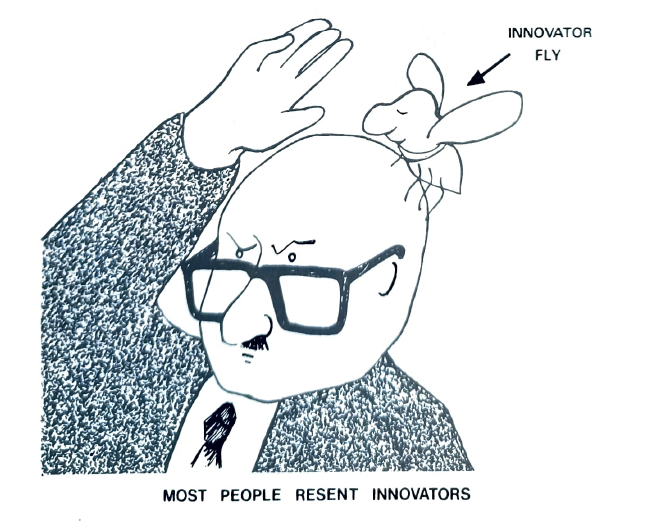
Consider how often one hears such words as ‘inspiration’, ‘flash of genius’, ‘accidental discovery’, ‘happy circumstance’ and such in connection with works of art or invention. This whole, somewhat coy attitude towards innovation is a lot of horsefeathers. Certainly, some people are better at it than others, but it is no more mysterious than other skills, and can be encouraged—or neglected—just as they are. To assume that some folks got it and some folks ain’t is a nonsense. All folks have got it in some degree; they simply don’t make the slightest attempt at developing it. Worse—they resent those who do. I’ll say that again—most people resent innovators.
Suppose I suggested that you are capable of finding any number of novel solutions to any given problem you happen to be faced with? In any sphere, that is, where you have a body of knowledge or a reasonable amount of experience? Well, it’s true. It may seem unlikely. But even now you have a niggling feeling in the back of your mind that it’s true, haven’t you? Well hang on to that thought. It may be superstitious but it’s damned useful.